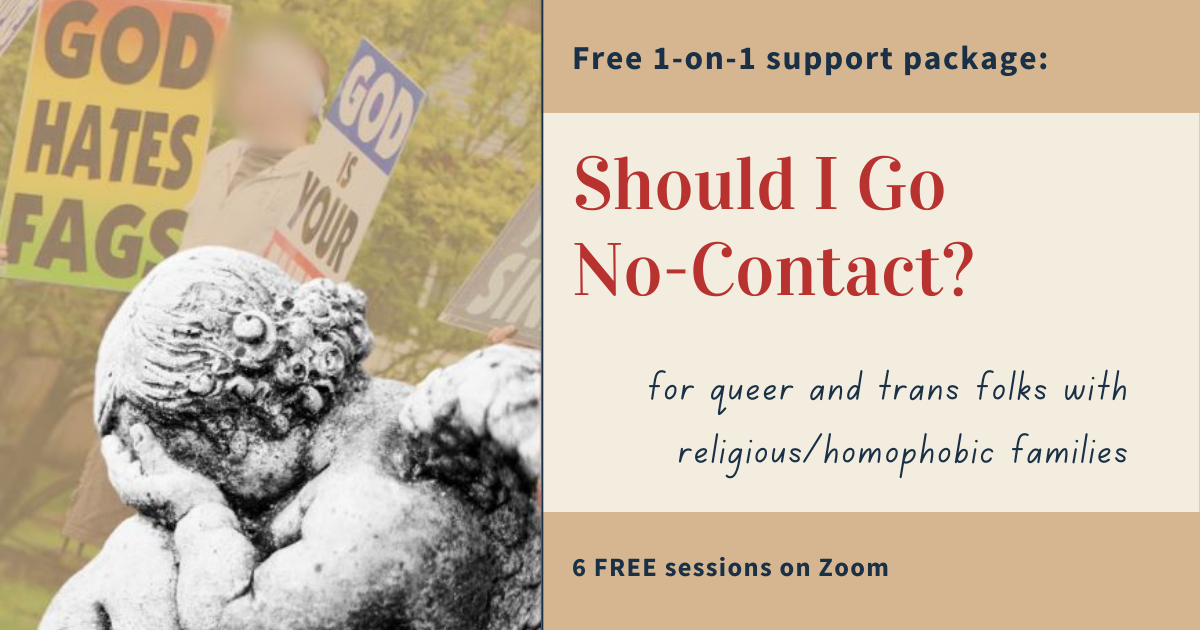
“Should I Go No-Contact?”

A new coaching package for LGBTQIA+ folks with conservative religious/homophobic families

Note: I am currently looking for 3 people to test this new program for FREE. Keep reading for full details. —Mary

Dear Queer/Trans Religious Trauma Survivor,

I’m so glad to meet you! I’m also really sorry that you’re here, because you probably wouldn’t be checking out this page if you didn’t have some pain in your family relationship (a little or a lot of pain). I’ve been through it myself, and I wouldn’t wish this pain on my worst enemy.

So, if you’re confused about how to relate to your homophobic family, I’d like to help.

Growing up in a deeply religious family, you probably worried that your family would disown you if you ever came out as LGBTQ+. When you did come out, if they didn’t disown you, you were probably grateful, right? And so hopeful! This is progress, right? Like me, you probably hoped that they would eventually accept you exactly as you are!

But now, maybe your relationship with your family is complicated and confusing. They tell you that they love you, but are any of these things true?

They want to change you:

  • They give you religious books and articles as gifts

  • They sneak religious topics into conversation, but frame it as “healthy debate” or “just my opinion”

  • They sneak religious topics and/or gifts to your non-religious kids

  • They keep inviting you to church services, religious movies, etc.

  • If you ask them to stop, they act like you’re the one who is persecuting them.

They don’t understand you, or really even listen to you:

  • They have no real interest in anything that falls outside of their own worldview. Maybe we all do this to some extent, but try this on: how much do YOU know about their worldview, compared to how much they know about yours?

  • While we try to understand and respect their right to believe what they believe, they may think it’s wrong to expose themselves to any other beliefs (including ours). This leaves a big gap between us and them, and they expect US to bridge that gap without their help.

  • It feels like the only way to communicate with them is to pretend that we believe what they do, and we can’t do that without scrambling our own brains. First of all, the things they believe in seem illogical and not-factual to us, and second of all, their homophobic/transphobic beliefs are toxic to us.

  • This long-term limbo is demoralizing and exhausting to us.

Interacting with them stresses us out, and sometimes it’s hard to even understand exactly why:

  • Going home to visit feels like an “out of body experience”. It’s like we have to pretend to be someone we’re not in order to even have a conversation with them.

  • While we’ve grown exponentially since we left home (deconstructing religion, meeting people from different cultures, meeting different LGBTQ people, following different news sources) they have stayed almost exactly the same. If anything, they’re trying NOT to expose themselves to anything new.

  • We hardly ever just talk to them about our lives without filtering it, because we know that they’ll freak out if we don’t sugar-coat it.

  • If we try just speaking our minds directly, they either look at us like we have two heads, or they blow up so that we regret saying anything at all.

We sometimes feel unsafe with them emotionally, psychologically, or even physically:

  • Disagreeing with them makes us feel panicky, because we’ll be judged (either openly or silently) and there will be repercussions later.

  • Many of our churches and/or maybe even family members have covered up abusive behavior within the family and/or leadership.

  • We’re expected to believe things that we’ve found to be untrue. We’re punished or shunned in some way if we don’t believe. If we pretend to believe, but we aren’t convincing enough, then we get interrogated about our thoughts and feelings. Our own minds and hearts do not feel like safe, private spaces. Believe me, this shit is EXTREMELY confusing to our nervous systems.

  • Even after we’ve been out of the church for many years, friends or family members may try again to get us to come “back into the fold”.

  • If your family hit you while you were growing up (James Dobson, Dare to Discipline), you may still have to witness family members hitting the young children in your family. Either way, you don’t need a therapist to tell you that this is PTSD territory.

  • If you complain about any abuse that happened in your childhood, rather than take responsibility for it, they work overtime to excuse or justify what happened.

  • Some religious families may disrespect or even sabotage your physical boundaries around anything from guns in the home, to seatbelts, to driving recklessly or drunk, to your dietary restrictions, to your Covid protocols, to car seats or what they feed your kids.

  • When you were a teenager, they may have forced you into conversion therapy to “overcome” your queerness. Even years later, you may be suffering from the after-effects of this.

  • As you’ve gotten older, it has started to feel like everything they say is fake. Like it’s all a huge game that they live inside, and they’re trying to convince themselves that it’s real. They’re mostly nice people but they’re not genuine people.

They claim that they don’t judge us, but they treat us like we’re unacceptable:

  • Maybe they’re polite but distant with your partner. Maybe they’re not rude, but they also don’t talk much or make any real connection…

  • …but if you don’t come home for Christmas, they act like you’re being unkind, because “families should be together for Christmas”.

  • They won’t use your name and pronouns.

  • They won’t attend your gay wedding, or you’ve put off getting married because you’re not sure how they’ll handle it. Sometimes you’re not even sure you want them there…

  • …but they’re super-excited about your sister’s wedding to an absolute nightmare of a guy that she’s only known for 6 months.

  • You can’t sleep in the same bed with your partner under their roof, even if you do get married.

  • Your grandfather dies, and you’re deadnamed in his obituary.

  • They imply (or state outright) that any health problems and/or disabilities you may have are caused by your “not being right with God”.

  • Your brother’s teenager comes out as nonbinary, but the family says that “calling people they/them is a lie before God… biology is biology” (smh).

  • You want to stick around, to be a resource for your younger siblings/nieces/nephews/niblings, but your family asks you to not hold hands with your partner in front of the children, because “We have values that we’re trying to uphold, and we can’t have them exposed to that sort of thing.”

  • You know they talk about you behind your back. For such nice people, their words are awfully cruel and judgy, and you hate to think of walking away, because you know they’ll judge you even harder.

They’re harmful to other people (including their own kids):

  • They’re racist and sexist (many of my clients’ families are racist/colorist, even if the family itself is BIPOC).

  • They vote for politicians who want to abolish same-sex marriage, create anti-trans “bathroom bills”, and violently deport immigrants to countries they didn’t even come from.

  • Even if your family is “not political”, you may sometimes be shocked to realize that they have no idea how their vote (or failure to vote) affects their LGBT kids. It’s like your gayness exists in some silo somewhere, completely separate from them and their political views.

How can such nice people be so hurtful?

Gradually you’ve realized that the problems are bigger and deeper than just you homophobia/transphobia. You want equal rights for everyone, you want everyone to be treated well regardless of race, ethnicity, sex, gender, disability, who you love, etc., while your family wants to go back in time to a world that never existed, to an idealized life where everyone looks and thinks and acts and worships like they do.

Apply to test this program for FREE!
Fern fronds and dewdrops in Portland, Oregon

Like me, you probably want your family to…

… love and understand you, and accept you as you are. And you’re not being unreasonable! You know they’ll probably always be religious, and that could maybe be okay. You just want mutual respect.

They can still talk about church, they just need to stop trying to change you. You’d be totally fine with “Hey, I saw Sally at church this morning. She had a new baby!” (with no expectation that you’ll go to church, or re-convert)

They don’t have to think exactly like you do, but you need them to make a real effort to understand you. Maybe you’d love it if they’d read a book about LGBTQ life, or go to a PFLAG meeting.

We still want to talk to them, we just need them to do their part so that it’s not so stressful and weird for us. We need them to meet us halfway.

They don’t have to agree with us about what’s safe and acceptable, but we need them to respect our boundaries, so that we can be physically, emotionally, and psychologically safe with them.

They say that they’re not judging us, but we need them to ACTUALLY stop judging us. We need them to stop treating us like second-class citizens, like sinners, like we’re unnatural, or invisible, or no longer really part of the family.

So what if you can’t have the perfect, affirming family? Then what you need is clarity. Clarity to see them as they really are, to understand why they stopped growing. Why they stayed stuck while you broke free.

If you don’t get clarity, you’ll have to keep going home for uncomfortable Christmas visits (or feeling guilty for not going). You’ll keep second-guessing why you feel so awful, while everyone else is smiling and happy to see you. You’ll keep feeling guilty for failing to enjoy superficial conversations with people who love you, but who also vote to violate your human rights. And you’ll keep thinking of yourself as the one who is “making other people uncomfortable” just by being there and being your queer/trans self.

Big blue sky, wispy white clouds, framed by Douglas Fir trees
Fall leaves on a boardwalk through an Oregon forest

…just sharing recipes and pictures of the kids, with an occasional, shorter visit. Or maybe you’ve tried pushing a bit harder, having tougher conversations with family members, but they either sidestep the issue, or gaslight you, or get angry and blame you for “causing trouble”. The mental gymnastics they go through are exhausting.

Or maybe you just keep going to all the family gatherings and keeping the peace, hoping for the best. Maybe they’re nice to your face, but then talk behind your back about how “lost” they think you are these days, and how they “just don’t know what happened to you.” They “don’t know where they went wrong.”

You’ve been patient, because you know that this is really hard for them! You tell yourself to have even more empathy for them, but you’re getting worn out from trying, and you’re just getting more and more confused. It seems like if you got graduate degrees in psychology, sociology, AND political science, you still wouldn’t understand your own family.

You may have already gotten support from therapy. This is a wonderful thing if your therapist is fully LGBTQIA+ affirming and not religious). Sometimes, though, a short-term, structured coaching package can get results on some topics faster, and can also be a great addition to the work you’re already doing in therapy. You may also have tried getting support from friends (who are supportive but not trained) and maybe self-help books, TikTok videos, and memes and articles on social media and the web. All of these can be great (especially therapy… I love therapy with the right therapist). But if you haven’t found clear enough answers yet, maybe you’d like some structured help with this specific question, from someone who’s been there, and who has helped other people to navigate this specific nightmare.

Maybe you’ve already tried going low-contact…

Apply to test this program for FREE!

Here’s where I’m supposed to tell you that you’ve tried all the wrong things…

…but I honestly don’t believe that. I think you’ve tried the right things. Believe me, nobody ever contacts me without trying a lot of things first. Unfortunately, most religious families who can’t fully embrace their LGBTQ+ kids are not just religious. Most of them (not all) have also been hijacked by one or more of the following problems that are intermingled with their religion:

  • Adult Children of Emotionally Immature Parents

  • Authoritarian abuse and coercive control

  • A parent or sibling with narcissistic tendencies (one person’s rage or crying controls the whole family)

  • Nostalgia for an America that never really existed, but that they want to “go back to”. These families feel safe with racism, patriarchy, and homophobia.

  • White Christian Nationalism

  • MAGA

  • Q-Anon

  • Low-information voting

  • Insular communities (where everyone believes the same as your parents)

These cultural systems are working overtime to keep your family members thinking the same way their parents and grandparents did. These systems are combining with religion, and stopping you from getting the full love and support that you deserve from your family.

Apply to test this program for FREE!
Banff, Alberta, Canada: road trip with cars, golden aspen trees, and mountains

Maybe you already know this (or maybe not), but religion itself is not necessarily the problem here, or at least not the whole problem. There are religious people/groups/congregations that really are LGBTQIA+ affirming. Even the Mormons and Catholics have affirming groups that operate outside of their respective churches. These religious-but-affirming churches and support groups have done their research on what it means to be queer or trans. They’ve worked to unlearn their homophobia and transphobia, and have thrown their doors open to us, choosing instead to love us, accept us, and in some cases even ordain us.

Your family members could have chosen an affirming path and kept some flavor of their religion, but most have not. WHY???? Why didn’t they become LGBTQ-affirming, social-justice-loving, egalitarian religious people? This question is at the heart of what we’ll explore together, and the answer is something that I refer to as “Such Good People” SyndromeTM.

“Such Good People” Syndrome is a term that I created to describe a cultural phenomenon where we’re not supposed to be upset when “good” religious people harm us with their “good” religion. My clients often tell me “I feel guilty, because I’ve brought all this confusion into my family. I know they love me, so why am I still so upset with them? They’re such good people.”

As we look more closely, we often find that my clients’ families are incredibly nice to people in their own, approved communities (their in-group), but they often lack compassion for people that they don’t approve of (their out-group). They may approve of people who look like them, worship like them, vote like them, and have the same citizenship. But they may not really care much for people who are from a different race, religion, political affiliation, or country. So they’ll bake casseroles for their church members but may be fine with deporting asylum seekers. So really, how “good” are they?

“Such Good People” Syndrome helps to explain why these folks are so hard on their own gay/trans kids. It’s heartbreaking to us, but in some way, by coming out as LGBTQIA+, we have become part of our family’s out-group, and they don’t know how to relate to us anymore. It’s a level of cognitive dissonance that they don’t know how to handle. So they lean even harder on religious and political systems that tell them they’re such good people. Unfortunately, those systems also tell them that we queers are bad.

“Such Good People” are often very good at compartmentalizing their thoughts. If your parents sometimes seem to completely forget that you’re queer, it may be because of this cognitive dissonance. They have always been taught that straight people are good and normal, and that queer and trans people are bad (or that trans people “aren’t real”). Because “my child is gay” doesn’t fit well into their existing thought structure (i.e. doesn’t fit well into everything they’ve believed for their whole lives), they have trouble integrating it into what they already believe. First, they may panic. Then, over the years, they may improvise: They may sometimes think that you only think you’re LGBT, or that it’s just a phase, or that you’re just confused. Some parents may even forget all about it at times, especially when talking with conservative friends/family (or when heading to the ballot box). They’re just being Good People. Good People don’t have queer kids. So when you’re not right in front of them, in your minds, you may kinda be filed under “not gay”.

In their confusion, they tend to smile to our faces, while emotionally holding us at arm’s length. It’s like they’re looking past us, or through us (it’s hard to describe, but if you’ve experienced it, you’ll know what I’m talking about). This, in turn, causes cognitive dissonance for us. “I know you love me, so why do I feel like your smile is a little fake, and you can’t quite make eye contact with me anymore? I haven’t changed. I’m just queer.”

If it’s relevant to you, in our 6 weeks together, we’ll talk a lot about how and why “Such Good People” seem kind, but vote to harm immigrants, and queer and transgender folks. We’ll talk about how they may say and do and vote for bigoted things, while everyone around them thinks that they’re wonderful and we’re the problem.

Sun peeking through trees and ferns in Oregon
Apply to test this program for FREE!

“I jumped out of the frying pan of fundamentalist Christianity, into the fire of Mormonism, left them both, and found myself pursuing social justice work as if it was a new religion. I had been unhappy for so long, and I had a string of unhappy relationships behind me.

I had come out as queer, and then as genderqueer, and then as a relationship anarchist, but it still felt like my old religious programming was hounding me. Thank you for helping me un-pack it all. It’s been hard work, but so worth it. I take care of myself now. I rest. I only keep relationships that are healthy and mutual. It’s amazing how much better life is when I know what I want and am actually willing to work toward my own joy, lol. Who’d have thought?” — Max: Boulder, Colorado, USA

“Mary is the absolute best and I can’t say enough about how much she has helped me. She deeply cares about people and she offers support, wisdom, and useful insight. She gives people concrete tools to work with too. Even during the depths of this pandemic, she manages to impart a sense of peace, calm, and hope. Mary clearly has a heartfelt passion for helping others. A bit about me: I am a tough nut to crack. And I have a graduate degree in clinical social work. It takes a lot for me to recommend anyone as a coach or therapist, but I recommend Mary without reservation.”

— Laura: Portland, Oregon USA

“You have helped me so much in my relationship to myself and to other people. You gave me the confidence to dig deep, and to know what is authentic for me. I’m a better parent, a better partner to all my partners… as a former Catholic, I now hold my boundaries better and I know more about who I am. I did this work myself, and I’m so proud, but you helped me do it so much better.”

—Irma: Rio de Janeiro, Brazil

Let me help!

What you really need is someone who can help you get clarity on how your family works, which of these systems are controlling them, how you might still try to heal things, and what to do if you can’t heal it all. I’ll help you learn how to make decisions that make sense for how your own family actually functions. I’ll walk you through making your own decisions that protect your peace, so you can live your beautiful queer life out loud, and without guilt. Let’s get you a clear plan for what you will and won’t put up with.

Why I’m the one to help with this:

I’m a queer, genderqueer, ex-Evangelical, neurodivergent weirdo who has helped hundreds of people to figure this shit out. I understand, and can viscerally FEEL what it’s like to look my family members in their smiling faces and feel so alone and confused and misunderstood and blamed, all while they’re telling me how much they love me. Every visit home used to be like an out-of-body experience.

Getting from confusion to clarity was a long and bumpy road for me. In the end, my family relationships are all over the place: I have a few family members would march in a Pride parade with me, a lot that I’m low-contact and cordial with, and some that I am completely no-contact with.

I’m in my 50s, with scars and life experience and empathy that make me an excellent tour guide through this difficult but rewarding journey. You will absolutely be stronger and freer when we’re done.

Who I used to be:

This dorky teenaged girl with the Peggy Hill glasses is me (I made that dress myself… I was so proud of that dress. Actually, I’m still proud of that dress!)

I grew up steeped in Evangelical/Fundamentalist Christianity. Sunday school, church, Bible study, choir practice, Vacation Bible School, morning devotions, church camp, you name it, we were there.

I was “that kid” who would wake up an hour early every morning to read my Bible and pray before school. I was also “that kid” who kept questioning everything. Why was the church so sexist? Why couldn’t I (a girl) be a preacher someday? Why did we preach so hard against abortion but do absolutely nothing to feed and clothe and house those babies after they were born? Why did we say that we believed the whole Bible literally, when in reality we took some scriptures literally, and completely disregarded other ones?

I never stopped asking those questions. I turned 18, left the church, moved a thousand miles away from home, and built a wonderful, authentic, hella-queer life for myself. At first, I was only out to my closest friends, but eventually I came out to my family (which is a long story for another time).

Many years ago when I first started my coaching career, I didn’t want to work with religious trauma at all. I honestly thought I wasn’t qualified, because my own journey was still so raw. It hit too close to home.

But as I worked with more and more clients on their relationship issues, the folks who were raised religious kept finding me, and they kept bumping into their own religious trauma. Let’s face it: homophobic religions are ALWAYS traumatic to queer and trans folks, because we grew up knowing that we’d be rejected if we ever figured out that we were LGBTQ+.

So as my religious trauma clients kept finding me, I found that I loved working with them, and I noticed that I was actually fantastic at helping others do this hard work! Having rescued myself from all that pain, nothing could be more natural than helping others figure out how to rescue themselves.

“Everything she says is well thought out, insightful, thought provoking, and without judgement or pressure to be anything other than myself. She is a wealth of knowledge and ideas, and a patient sounding board. I loved that her skills went above “listening” and extended into encouraging me with workable action steps between sessions. I wouldn’t be the successful, happy, and “unstuck” person I am today without her help!”

— Megan: Clearwater, Florida, USA

You can figure this out, and with minimal fear and guilt!

I’m laughing at myself, because I feel like if I promise you that you can make guilt-free decisions about family, you won’t believe me. I mean, those of us who grew up deeply religious can hardly do anything completely guilt-free, right? We’re so afraid of hurting people, even if they’ve already hurt us, and I think that this is a good thing overall! It’s just sometimes out of balance and unrealistic. In this program, we’ll look closely at who’s responsible for what, what’s yours to take care of, and where any leftover guilt belongs.

Also, the fear within us is so understandable. If we were raised with a fear of hell and damnation, or outer darkness, or spending eternity away from our loving families, it’s only natural that we have a visceral fear of displeasing people (I mean, if God is cruel enough to banish us for all eternity, why would we expect any better from people?)

So let’s look the fear and guilt in the face and take them apart. You’ve already left home, deconstructed, come out of the closet, and built a life for yourself, so let’s go a few steps farther and clear up your family relationships!

I’ll help you to clarify for yourself:

  • What is your family’s responsibility, and what is yours, so that you no longer try to solve problems you can’t solve.

  • What respectful behavior from them would look like (i.e. what you should insist on, and what you should not put up with), so that you don’t expose yourself to their damaging behaviors and toxic opinions.

  • What they must do to actually be safe for you, so that you feel confident in staying away from painful/unsafe situations.

  • What it would look like to build a bridge, them toward you and you toward them, meeting in the middle, so you know what halfway looks like, and you stop doing all of the work.

  • If they won’t meet you in the middle, how close is “close enough”

  • How to talk to them to avoid having to deal with blowups or the silent treatment, so you don’t put up with any more soul-destroying drama.

  • We’ll probably play about a million rounds of a game I call, “Should I feel guilty about this???” So often, our families’ demands are completely unsafe or even impossible. Should we feel guilty for not doing things that harm us? Should we feel guilty for not doing things that are are impossible, or that require the help of someone who refuses to change or contribute?

Once you have more clarity on these things, some of your family’s hold on you will loosen up, and you’ll be able to focus on YOUR best life, and how to live it to the fullest. You’ll also stop blaming yourself for being unhappy, because you’ll understand that they’ve been hurting you in very valid ways (while you were maybe excusing or covering for them in your heart).

Will your family still matter to you? Of course! Whether you’re able to create a healthy relationship with them, or you go low-contact, or no-contact, I think they’ll always be important to you. But you’ll have the strength and wisdom to stop trying to get their approval. I don’t think you’d be reading this page if your family wasn’t harming you in some way(s). We need to stop that harm one way or another, so that you can either relate to them on terms that are healthy for you, or walk away. Either way, you’ll be well-supported.

When you change how you relate to your dysfunctional family, ALL of your other relationships will improve, because YOU will be changing and getting stronger.

Ya know how maybe some of your other relationships are confusing too? (Partners, friends, coworkers, bosses…) Maybe some other people in the past or present also haven’t treated you well or respected you? These relationships will all get better too. I’ll show you how.

And in case I haven’t made it clear enough, I will never, ever try to push you to go no-contact with anyone. Never. For many people, it is not the best option. What I’m offering is a deep search for answers, a lot of clarity, and support for whatever you decide.

Fall leaves on a boardwalk through an Oregon forest

A 6-week coaching program to help you:

  • Understand your religious, homophobic family more completely

  • Learn about “Such Good People Syndrome” and why you still feel so hurt by their seemingly kind, loving actions.

  • Let go of guilt for not being able to fix this on your own (remember, they need to meet you halfway, or very close to halfway)

  • Learn how to set and hold your boundaries (even when you kinda don’t want to because it makes you feel like you’re the asshole)

  • Get strong and clear about what you will and won’t put up with, so that ALL of your relationships get better

Benefits of signing up:

  • You’ll have me as your coach for 6 one-on-one sessions on Zoom (so we can meet no matter where you’re located)

  • Each session is 75-minutes long, so that we have lots of time to get into the deep questions, and help you figure out how you’ll use this new information.

  • Make the sessions comfortable for you! Want to paint or draw or eat snacks or cuddle your pillow or play with fidget toys while we talk? Lots of my clients do this! Don’t enjoy a lot of eye contact? No problem at all! Be cozy! Be yourself!

  • You’re welcome to email me between sessions, and I’ll be happy to provide quick answers and emotional support. This is hard work, and I want to support you along the way!

  • Surveys and worksheets to help you understand your own family and see how it works as a (probably complicated) system.

  • If you have a therapist that you’d like me to coordinate with, I always love doing this. I include one free 30-minute consult with your therapist (and more consults are available on request, at a reasonable cost).

Here’s what we’ll do in our 6 sessions together:

  • We’ll start by getting to know each other, you and I. You can tell me a lot about your childhood, your religious and family background, and what your life has been like since you left the church. All the ups and downs. Feel free to be really messy about this! You’re also welcome to ask me about my background and how I’ve changed my family relationships.

  • We’ll talk about your coming out story/ies. How did your family members handle it, and what has it been like for you since then?

  • Obviously it hasn’t been all sunshine and rainbows. If it had, you wouldn’t be thinking about signing up for this coaching package. So what’s it been like? Has your family made progress? What has felt good and loving, and what has felt alienating, confusing, and painful?

  • We’ll look at several areas that are probably driving you and your family farther apart, including mismatched values, mismatched emotional maturity/relationship skills, and mismatched levels of empathy.

  • We’ll spend some time talking about “Such Good People” SyndromeTM and why good people are sometimes so hard on their queer/trans kids

  • We’ll assess your family’s systems, to see if your family suffers from authoritarianism, coercive control, emotionally immature parents, white Christian nationalism, low-information voting, and especially insular communities (most high-demand religions are extremely insular).

  • We’ll brainstorm things you might want to do instead of going no-contact, and we’ll look at guilt-free ways to spend more time with your supportive family members, and less with the homophobes.

  • If it applies, we’ll look at the tricky business of “covert allies”. These are family members who support you, but only in secret (they text you “Happy Pride!!!” but only on your individual chat… they don’t want to “upset” mom and dad).

  • We’ll spend a lot of time just being supportive of you. We won’t rush anything, ever.

  • At the end of our time together, you may not be ready to make a decision yet. That is completely okay. You don’t ever have to make a decision. I’ll still be here. You can stop altogether, or take a break and come back for more support later, and my then-current coaching rates. It’s all up to you. But you’ll have gained a lot of clarity, you’ll be a lot stronger and more confident, and your relationships will be better for it.

“Should I Go No-Contact?”

Apply to test this program for FREE!

I’m looking for 3 “beta testers” right now, to go through this coaching package with me for free.

Why would I do that? Because although I’m confident in my coaching, and in the material we’ll cover, this is the first time I’ve developed a short-term “coaching package” on this topic. I’ve walked many of my clients through this process, but they were all doing weekly, long-term coaching with me. We didn’t have a structure or a timeline. We just talked about these things as they came up. So I’m looking for a few people to try it out with me for free, while I tweak the details of the package itself. I have not settled on a final price for this package (I may change the number of weeks, and what I offer between sessions), but it will likely start at around $495.00

This coaching package is for you:

  • If you are LGBTQIA+, an ally, or a parent or family member of an LGBTQIA+ person

  • If your family is homophobic/transphobic (either openly or quietly)

  • If your family is part of a religion that teaches some version of homophobia/transphobia

This is not for you:

  • If you are under age 18 (I do not work with anyone under age 18)

  • If you live with, and/or are financially dependent on, the people you’re thinking of going no-contact with. I need you to have enough distance and independence to make this decision safely.

  • If going no-contact would in any way jeopardize your physical or financial safety, or the stability of your housing.

Still have questions? Please contact me here.

I will be on your side the whole way through, as we assess how you interact with your family. You might be both attracted to that idea and afraid of it, because most of us were taught always to discount our own needs, and to never think of ourselves. “Don’t count the cost.” Always serve others. Obey.

That is exactly why you need someone like me saying, “I just don’t think she should be saying this to you. It’s cruel.” Or “We need to find a way to save your health… so we either need to modify this situation or end it.” I’m here to be a voice that helps you to take care of your mental and physical health, even if everybody else thinks you should just stay and cooperate. I want you to have joy and peace in your life, even if it means making (well-supported) difficult changes.

No matter what you eventually decide to do, there is freedom and calm on the other side of this difficult journey.

Frequently Asked Questions

Still have questions? Take a look at the FAQ or reach out anytime. If you’re feeling ready, go ahead and apply.

Apply to beta test this program for FREE!
  • Getting started is simple. Click the button and fill out my no-obligation application form. I’ll get back to you within 48 hours.

    After I review your application, if it looks you might be a good fit for this program, then I’ll invite you to do a free one-hour Zoom call to talk about the program in more detail.

    After our Zoom consultation, If we both think that we’re a good fit, then we’ll schedule your Zoom sessions and set up your payment plan. My scheduling system accepts credit/debit cards and PayPal. (Beta testers will go through the program for free, and do not need a payment plan).

  • Then let’s talk about it, and if you need to stop, we’ll stop (including stopping your future payments). Sessions that you’ve already paid for will be nonrefundable (in most cases… talk to me), because I held those spots for you. But if you need to take a break, or stop completely, then I encourage you to take care of yourself.

  • That is a thousand percent okay!

    Most of my clients are still in contact with their families, even after going through this program. They only go no-contact when the other options are just too painful.

    The most important thing is to explore why you’re hurting, and figure out what you will and won’t put up with, and then learn how to set and hold healthy boundaries, WITHOUT GUILT. I love helping people with that.

  • Yes! With your written permission, I’d love to have a free consultation with your therapist, to coordinate care, so that we can support you in the best ways possible. My fee for one consultation between me and your therapist is included in your package price, and I can do additional consultations at a reasonable cost.

    Check with your therapist to see what their fee(s) might be.

  • Absolutely not, although it’s fine if you hate it! Some religious people lead with love first, and never judgment. Some religious people are completely LGBTQ+ affirming. I really don’t think that religion itself is the problem. I have a problem with specific homophobic/transphobic dogma, and with high-demand/high-control religions that teach people to have an in-group and an out-group.

  • Absolutely! Navigating family is a big job for parents and other family members of queer/trans folks (especially kids), and I would absolutely love to work with you.

  • WELCOME SIBLING!!!

    I am neurodivergent, non-monogamous, chronically ill, Covid-cautious (yes, still in 2026), and am invisibly disabled (hypermobility/chronic pain).

    I understand these things from personal experience, and love working with folks who have these shared experiences!

My clients say:

“I struggled both with my sexuality and with people pleasing. You helped me to clarify my values. You helped me to know what is healthy for me and for the people around me. You helped me to tap into what is truest and best in me. I am so glad that I decided to work with you Mary.”

—Honorine: Kigali, Rwanda

“Why didn’t I find you sooner??? I feel more like myself now. I feel like I can be weird with you, cry, be messy, and you’re not judging me. You helped me figure out things that I didn’t think could be figured out, and I’m stronger for it.”

—Anon: Tokyo, Japan

“I have found Mary to be an empathic, non-judgemental, excellent listener. Her easy-going demeanor and no-pressure approach makes for easy exchanges and trust. If you are looking for an authentic, one-on-one coaching or support group experience, I highly recommend Mary.”

—Donna S: Portland, Oregon, USA